Study: Aerial Surveillance And Memory Give Ravens An Edge In Yellowstone’s Wolfscape
It was long assumed that these amazing corvids could thrive just by following wolves to carcasses. But research shows raven intelligence leads them to a much bigger bounty
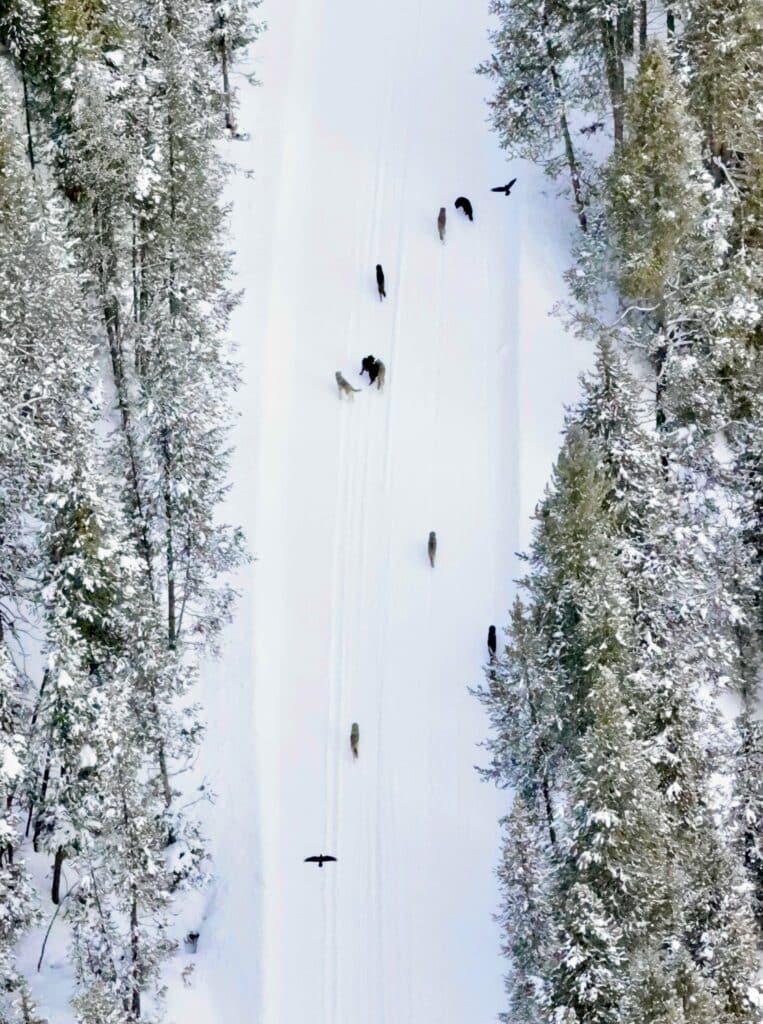
A bird's eye view of ravens and wolves in Yellowstone, both in this photo taken by researcher Dan Stahler and metaphorically as demonstrated in the recent study examining the relationship between predators and scavengers in the Yellowstone ecosystem
by Todd Wlkinson
In wild Nature, as in human communities, there’s a lot of socializing going on. Neighborhood denizens keep an eye on one another—watching closely, learning by what they see, hear and smell. They’re able to discern their own next moves based upon past and current experiences.
Being a keen observer, when it involves the challenge of finding enough to eat, brings fitness advantages for survival and reproduction, especially amongst the category of living species known as scavengers.
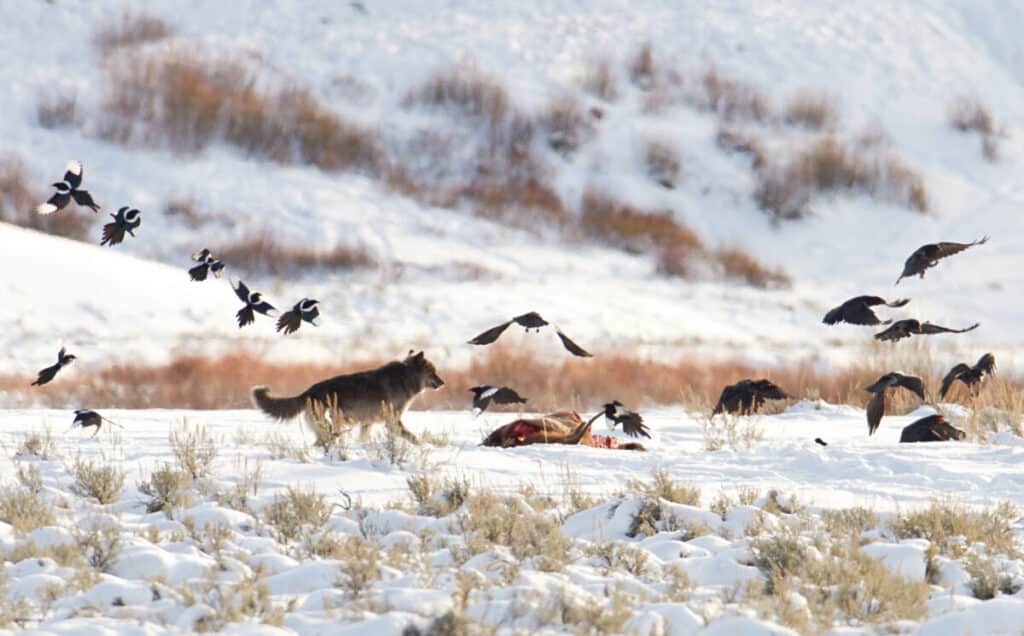
In Yellowstone National Park, researchers over the years knew that scavenging ravens were smart, possessing remarkably perceptive powers in their bird brains. And, for decades, scientists have posited that there’s far more than a passing coincidental relationship between the presence of ravens, wolves and the ability of the former to quickly identify and arrive at kill sites of elk, deer, moose and bison, created by the latter.
Still, the relationship between ravens and lobos, the mystique enhanced by archetypal symbolism of, has long intrigued those on the front lines of chronicling the dramatic intra-species theater playing out every day in America’s most iconic wildlife nature preserve. A new multi-author study published in the journal Science is chock full of insights. Titled “Ravens anticipate wolf kill sites across broad scales,” it focuses on the spatial relationship between ravens and wolves in Yellowstone, with allusions, too, to cougars.
The study involved 69 ravens fitted by satellite tracking devices and it correlates their behavior and movement with 20 radio collared wolves, 11 cougars, and the ungulate kills those predators made.
A healthy guide of carnivores, in this case, wolves, help support a diverse guild of mammalian and avian scavengers in Yellowstone by providing carcasses. Such biodiversity is important in keeping the ecosystem resilient against all kinds of landscape-level changes happening now and projected to increase in decades ahead. Photo courtesy Jim Peaco
For co-author Dan Stahler, Senior Wildlife Biologist at Yellowstone and Wolf Project Leader, who also has an interest in avifauna and directs the park’s examination of cougars, the study represents an important foray into pondering the multi-dimensional aspects of large landscape conservation and a full suite of native biodiversity.
“From my early work on ravens and wolves following wolf reintroduction, we all assumed that the birds had a very simple rule; just stick close to the wolves,” Stahler said. But the assumption was untested. “We didn’t know what ravens were capable of because nobody had ever put them at the center; nobody had taken the scavenger’s point of view,” he added.
Can ravens make a living simply by following wolves? This was top of mind for lead author of the study Matthias-Claudio Loretto, assistant professor at the University of Veterinary Medicine in Vienna, and colleagues. Employing their tracking tools across the study’s 2.5 years, they collected nearly 650,000 locations from nearly seven dozen ravens, 77,000 locations from 20 wolves (comprising six packs and one loner) and 58,000 locations from 11 cougars. Stahler praises Loretto for spearheading the study that was complemented by Yellowstone’s giant and growing database on wolves.
Dr. John Marzluff, also a coauthor on the study, is a professor of wildlife science at the University of Washington and an ecologist renowned for his studies of avian intelligence, especially that of ravens and crows. His book, In the Company of Crows, written with and illustrated by noted nature artist Tony Angell, is a must-read on the topic.
Marzluff says ravens are incredibly intelligent opportunists. While they don’t hunt ungulates themselves, they know that wolves do.
These largest members of the crow, or corvid family, remember where and when they found carrion before and the information related to this spatial mapping is passed down intergenerationally. Documenting the behavior made researchers realize how the quest to find sustenance among scavengers—a classification applied to a wide suite of species—is more complex than previously known.
Marzluff said scavengers dwell in the shadow of predators that attract most public attention yet their sensing capabilities are no less sophisticated, especially, in the case of ravens, their possession of a spatial and temporary memory.”
“The thing that surprised me the most is the scale at which ravens seem to know the landscape. We had some birds traveling thousands of square miles, in some instances from the Lamar Valley to Bozeman and in-between they know where all kinds of different food source are. They not only keep a detailed map in their memory but it’s time-relevant to season.”
“The thing that surprised me the most is the scale at which ravens seem to know the landscape. We had some birds traveling thousands of square miles, in some instances from the Lamar Valley to Bozeman and in-between they know where all kinds of different food source are. They not only keep a detailed map in their memory but it’s time-relevant to season.”
—Study co-author Dr. John Marzluff
In Yellowstone, Greater Yellowstone and other wild corners of the West, there’s a lot going on out there, stuff likely not readily discerned by humans passing through. Ravens, Marzluff said, process a variety of different cues. They keep track of the movements, sounds, and activities of other scavengers. If its other avian scavengers they take note of their flight paths, and in the case of ravens themselves, they listen to what’s being said in vocalizations. They also seem to have an understanding of nuances in wolf behavior, whether they are traveling, howling, and actively hunting, according to the study’s authors.
In books they’ve written separately in the past, study co-author Marzluff, and the late cultural anthropologist Richard Nelson have alluded to accounts from indigenous people in the Pacific Northwest and Alaska noting that ravens will draw attention to the presence wounded ungulates through cawing, almost as a summons for wolves.
The birds have a difficult time opening up a carcass hide with their beaks and thus wolves and their canid teeth provides swift entrance. Similar references have been made by noted wolf researchers like Drs. L. David Mech and Rolf Peterson in Minnesota and at Isle Royale National Park with moose.
Mutualism, i.e. different species benefitting from another’s skills, can take many forms and the new study in science illuminates a few more. “Knowledge of a resource landscape by ravens aligns with similar strategies observed in blue whales tracking spring phytoplankton blooms or chimpanzees using long-term spatial memory to revisit fruit-bearing trees,” the authors write. “The same mechanism might also be used by other avian scavenger species with high movement capacity (e.g., other corvids, vultures, eagles) to complement their physiological, morphological, and behavioral adaptations for efficient carrion detection.”
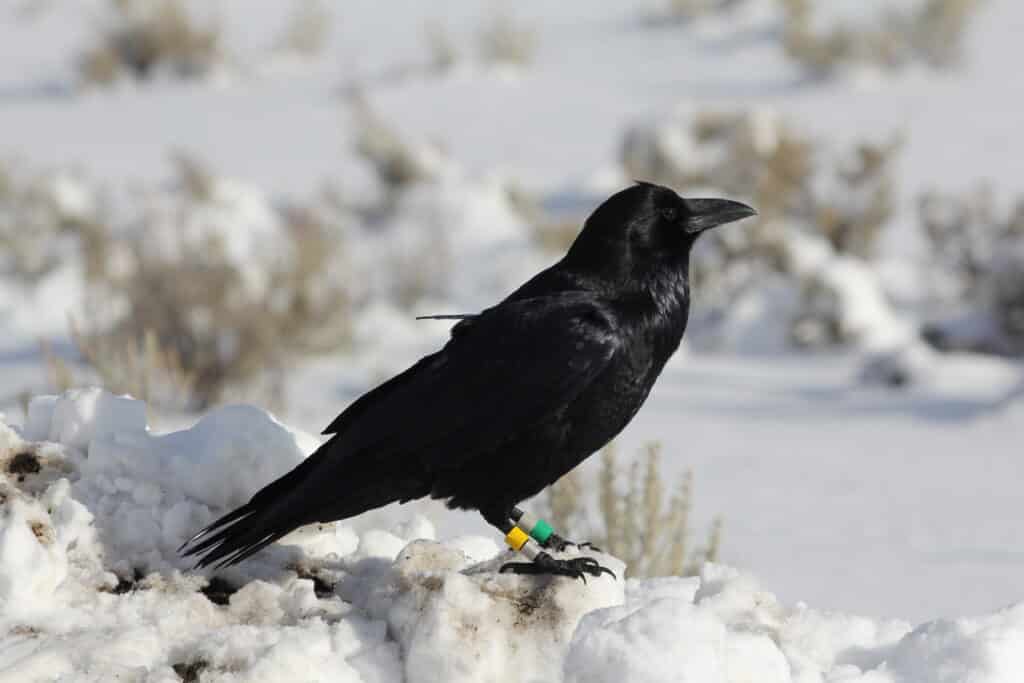
One the ravens equipped with a satellite tracking device as part of an unprecedented study examination behavior of the smart black birds amid a landscape of carcasses provided courtesy of wolves and cougars. Photo courtesy Matthias-Claudio Loretto
Wolves and ravens in Yellowstone are marvels of co-existence and it begins early in their lives. “Young ravens hatch around the same time wolf pups are being born,” Stahler says. “As soon as pups come out of the den, ravens are likely to be close-by for the rest of a wolf’s life. We’ve witnessed ravens being in the company of pups and going up and pulling on their tails.”
While the presence of ravens on carcasses seems to provoke younger wolves, often resulting in frequent flushing and even inter-species play behavior, adult wolves accept it as part as something that comes with the terrain. Within the raven world there’s a territorial pecking order. Mated pairs hold and defend nesting territories, and if first to discover carcasses, will display territorial behavior and control food access when dealing with small numbers of juvenile vagrants. However, younger ravens know how to confound these territory holders. They will give distinct recruitment calls, as a message to others vagrants that food has been found, and in greater numbers they’ll overcome the food defense of dominant ravens thereby increasing feeding opportunities.
Humans unintentionally create food centers that ravens take advantage of—things like landfills, sewage ponds and sloppy containment of trash, especially in gateway tourist towns located on the edge of federal lands. In their circuits of movement , ravens become accustomed to finding food in human dominated environs and, in some ways, it is parallel to birds in urban areas showing up regularly to feeders.
Although Yellowstone managers take strict measures to limit exposure to unnatural human foods in order to prevent animals from becoming habituated, ravens’ craftiness often thwart those efforts, as seen by some individuals’ proclivity to lurk at picnic areas and road pullouts in hopes of a food reward.
Ravens know that wolves can lead them to food. Finding a carcass, because it can take days to consume by predators and scavengers, holds higher value for ravens than, say, making the rounds in a tourist town.
Rather than waiting around as stationary sentinels for wolves to make a kill, research shows ravens engage in regular aerial surveilling across larger areas, essentially covering more ground and transcending the boundaries of differing wolf pack territories to see which groups might be having success. Marzluff said there was only one instance where a raven “followed” a wolf. In their regular searches, individuals and groups of avians could travel over 100 miles in a few hours.
Rather than waiting around as stationary sentinels for wolves to make a kill, research shows ravens engage in regular aerial surveilling across larger areas, essentially covering more ground and transcending the boundaries of differing wolf pack territories to see which groups might be having success. Marzluff said there was only one instance where a raven “followed” a wolf. In their regular searches, individuals and groups of avians could travel over 100 miles in a few hours.
A noteworthy reference to their intelligence, researchers say ravens have “future-planning abilities” similar to great apes and “show elements of theory of mind” that enable them to predict in advance where carcasses are likely to be based on observing the decisions of scavengers and large carnivores made in their movements. Indeed ravens anticipated the location of wolf kill sites across large areas.
In our interview Marzluff noted how on a day that an elk was killed in the Lamar Valley, a raven then sending signals from Billings found its way to the carcass not long afterward. It flew over the Absarokas, above Granite Peak (highest summit in the range) and joined others in feeding on the wapiti. It wasn’t owed to some clairvoyant power, but to the fact its flight path, based on a number of factors put it on that trajectory. In addition, it isn’t as imperative that ravens arrive on a carcass immediately after a wolf-kill is made. As research shows, higher numbers of ravens show up to scavenge larger carcasses.
Stahler, who has overseen the Yellowstone Cougar Research Project since 2014, said that having the data on cougars readily available allowed researcher to look at relationship difference between corvid interactions with canids vs. felids.
Wolves are coursing, group-hunting predators in that, within their territories, they chase prey like elk and bison in hopes of detecting the more vulnerable, safer to kill targets. Cougars, meanwhile, are solo stalking, ambush predators, and their behavior is both more cryptic and harder to visually track by humans and ravens alike because of the topographically rough and forested terrain they inhabit. Also, whereas wolves often make kills in open areas where it’s easier for ravens to detect carcasses, cougars cache their kills for the precise purpose of concealing it from scavengers.
Yellowstone Park itself is not, of course, a small wholly contained neighborhood, and functions ecologically as a centrifugal wheel of animal movement flowing in and out, with tentacles that reach to the far geographic limits of the ecosystem and beyond. The greatest insight is just how far ravens travel in their aerial searches to identify carcasses provided by wolves and cougars—and that the locations are stored in their memory. One bird in the study few to Edmonton, Alberta, Canada 750 miles away.
“Although the precise location and timing of specific wolf kill events are unpredictable, the broader spatial distribution of kill sites and carrion in general is largely driven by landscape features that create predictable hunting grounds. In these areas, predation risk for elk, the main prey of wolves in this system, can be up to 10 times higher than the landscape average,” the study authors write. “In winter, these zones—high- risk for prey and high-reward for scavengers—are typically flatter, open, snow- covered grass- lands near streams and roads, habitats that are easily searched by wide- ranging aerial scavengers such as ravens.”
Together, members of a Yellowstone wolf pack and ravens ply a snowy corridor, part of a co-existence that begins for both early in their lives. Photo courtesy Dan Stahler/NPS
Ravens aren’t the only patrons dining at the smorgasbord. While they are commonly associated with carcasses, they have a varied diet based on what’s most abundant in the larder. “They always have town [of Gardiner], the dump, and sometimes pull outs in the park where they’ll beg,” Marzluff said. “In summer they often eating insects, or, earlier, eating salmonflies or, later, catching grasshoppers. And they’ll switch to things like roadkills— large animals and ground squirrels. Yes, they have wolf kills and it’s a good deal when available but they have all of those other options.”
In a dynamic system supporting healthy numbers of predator and prey, there is a lot of carcasses. However, Marzluff noted: “Yes, it’s a good place to be a raven, but you’ve got to cover some ground if you’re feeding on carcasses and you have to be quick in arriving. They don’t last very long.”
Marzluff remembers when the first raven was captured and fitted with a GPS tracker. “It flew all over the place, which kind of surprised us. Doug Smith [then the avian specialist] made an observation that is apropos. He said, ‘This is hungry country.’ No matter who it is.”
As Stahler noted, “the beauty of Yellowstone in this modern era of restoration, is that it’s not only an iconic ecosystem with ecological resilience and high societal value, but it provides a unique opportunity for long-term science. Monitoring of ravens’ relationship with wolves has now spanned nearly 30 years, and we’re still making new discoveries about animal relationships, intelligence, and the importance of large, wild landscapes for species persistence.”
In addition to Loretto, Marzluff, Stahler and Smith, other major contributors to the study are Kristina Beck, Lauren Walker, Martin Wikelski, Thomas Mueller and Kamran Safi.
Todd Wilkinson, co-founder of Yellowstonian, has been an award-winning American journalist for almost 40 years, known foremost for his writing about the environment and his knowledge of the Greater Yellowstone Ecosystem. In addition to his books on topics ranging from scientific whistleblowers and Ted Turner to Grizzly 399 (that book featuring images by photographer Tom Mangelsen) and coffee table volumes on a number of prominent fine artists, Wilkinson has written for National Geographic, The Guardian, The Washington Post, Christian Science Monitor and many other publications. He started his career as a violent crime reporter with the City News Bureau of Chicago. He is also a writing fellow of the Northern Rockies Conservation Cooperative based in Jackson Hole.
Jon Fossel climbed a towering ladder of success in New York City but his greatest feat was embracing restraint to save a magical corner of the wild West from ruin
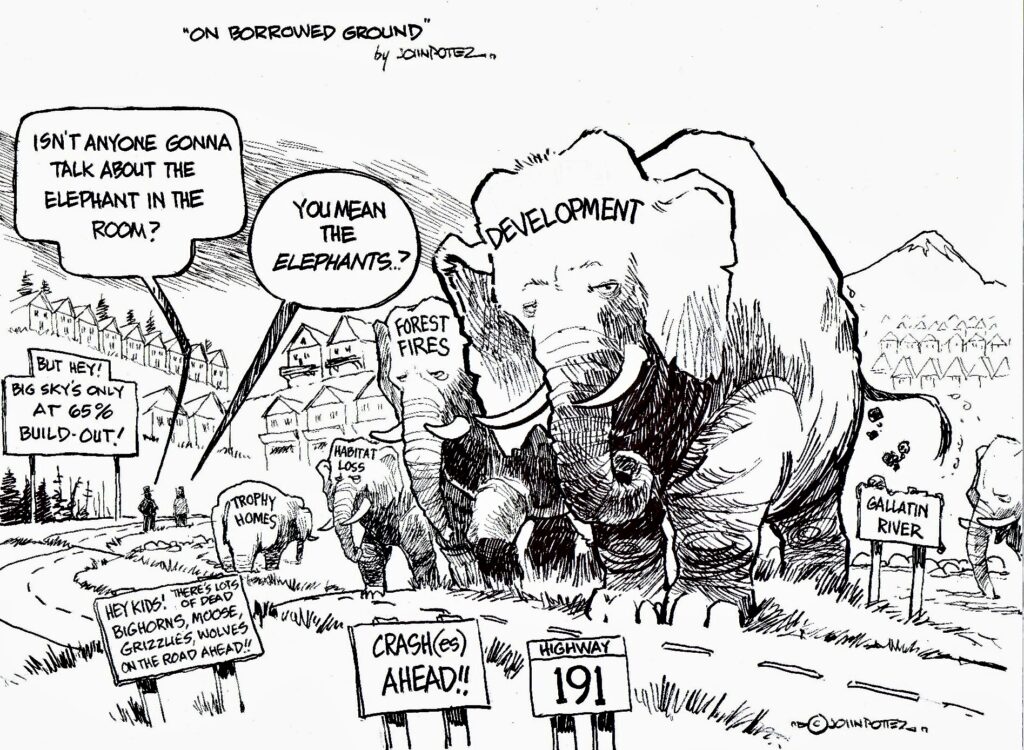
Welcome to Big Sky: In his latest cartoon, John Potter sheds light on the real cause of rising wildlife roadkills along US 191, pollution threats to the Gallatin River and the loom of catastrophic wildfire. Developers, he says, would rather pretend these elephants in the room don't exist
What lessons, if any, did Jackson Hole Grizzly 399, the most famous mother bear in the world, teach us about co-existence? New book by Susan Clark and Ana Lambert explores the question—and in this story you can download a free digital copy!