NOTE: On March 4, US Sen. Steve Daines of Montana announced he would not seek re-election three days after the story below appeared.
by Todd Wilkinson
In the American West, realm of big landscapes and human personalities to match, some might find it amazing how those with the largest soapboxes in shaping the region’s future are running for cover. Politicians aren’t mixing it up with constituents because they’re afraid, apparently, that by being confronted with difficult questions it might jeopardize their chances at re-election.
Whether the topic is civil service and federal land management agencies still reeling from the short-lived tenure of the Department of Government Efficiency (DOGE), the real negative consequences of tariffs on struggling rural agrarians, business entrepreneurs and working class families, or proliferating attempts to weaken environmental laws, including the protected status of public lands, members of various Western Congressional delegations are evading legitimate, non-partisan concerns being raised about the consequences of their actions.
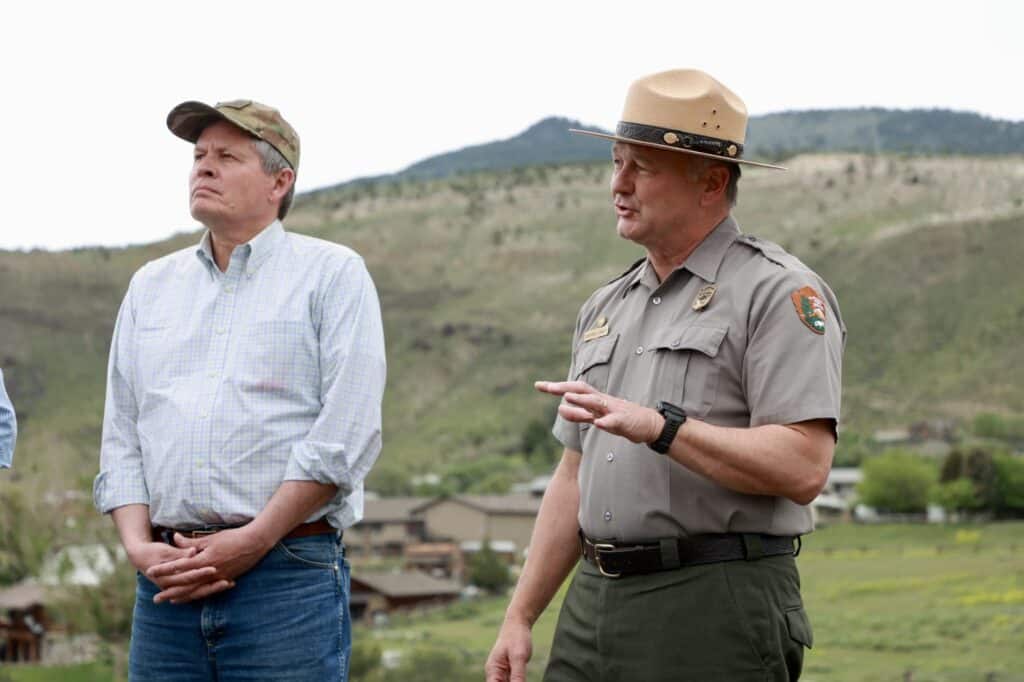
Today’s focus is mostly on US Sen. Steve Daines of Montana who has a seniority position on the Senate Committee on Energy and Natural Resources as well as a close relationship with the president of the United States. Senate Energy and Natural Resources has tremendous influence over decisions shaping the American West. The committee chairman is US Sen. Mike Lee of Utah, best known of late for trying to dispense with millions of acres of federal lands. Ranking Democrat on the committee is Martin Heinrich of New Mexico. Joining them from the Rocky Mountain region are Sens. John Barrasso of Wyoming, James Risch of Idaho, as well as John Hickenlooper of Colorado, plus Lisa Murkoski of Alaska and 13 others.
Daines has, at best, an inconsistent record when it comes to protecting public land. On deferred maintenance and infrastructure needs of Yellowstone National Park, for example, he has been a fierce ally of park superintendent Cam Sholly, securing funding to help Yellowstone rapidly rebuild after flash floods destroyed park roads in 2022. That said, Daines has been less supportive on issues of bison management and enabling those icons to roam further outside the park. Daines also favors removing grizzlies from federal protection so Greater Yellowstone bears can be hunted, and he favors maneuverings, read here and here, that, ironically, would make delisting illegal.
In 2025, when anonymous agents with the newly-created Department of Government Efficiency implemented abrupt layoffs of thousands of National Park Service, Forest Service and employees of other land management agencies in the West, devastating morale, Daines, who claims government needs to be run more like the private sector, said little. DOGE slashed budgets, targeted science-gathering capacities, sought to close down facilities, and carried out a chaotic re-organization. Again, Daines said nothing even though it negatively affected hundreds of his constituents who work for federal agencies and their families. He and other GOP members of the Senate Energy and Natural Resources Committee welcomed DOGE, feeding the false narrative that agencies were bloated. I’ve spoken with no fewer than a dozen employees of the Park Service, Forest Service and other agencies in Greater Yellowstone who say they dwell in fear for their jobs as never before, and, further, directives handed down from political appointees in the Interior and Agriculture departments in Washington DC have ordered them to stay silent.
Lastly, in spite of irrefutable evidence of how human-caused climate change is altering Yellowstone and the ecosystem encompassing America’s first national park as well as, more largely, his state— the senator is defiant in refusing to acknowledge how turbo-charging increased burning of fossil fuels is expected to cause much warmer drier conditions in the interior West that will negatively affect mountain environments, water availability and ag economies in years to come.
° ° ° °
Daines credits his early impressionable years as a high school speech and debate champion for informing the way he allegedly considers evidence and how he conducts himself as the highest elected federal official in his state, sent off to Washington DC to represent the peoples’ best interests. Among several of his recent maneuverings on environmental matters, consider just two:
Senator Daines, who hails from Bozeman, recently led an effort, with help from his friend, President Trump, to re-open two million acres of public BLM lands in eastern Montana to coal mining. He is making sure, also with assistance from Mr. Trump, that coal-fired power plants, slated for de-commissioning, remain in operation, and he’s cheering efforts by political appointees now in charge of the US Environmental Protection Agency who deny that human-caused climate change exists.
From now on, it seems, the nation’s top environmental agency will pretend that smokestacks and millions of vehicles running on fossils are not, in fact, sending vast loads of carbon dioxide into Earth’s atmosphere; it means they are basically denying that the greenhouse effect, first identified in 1824, exists.
Separately, Daines is pushing to remove protection from three wilderness study areas in Montana totaling around 100,000 acres found on federal national forest and BLM lands. This may seem insignificant but it’s related to the first in how it ignores science. Both involve the issue of whether politicians can be trusted to tell the truth, especially when it’s the truth that the public needs to hear rather than a truth we would rather just pretend that isn’t.
What the senator’s doing, observers say, is assuming the public isn’t paying attention to his strategy of trying to abolish a whole suite of WSAs piecemeal. It’s a new tactic Daines adopted after he and Montana Gov. Greg Gianforte tried, unsuccessfully, to eliminate dozens of WSAs back when Gianforte was a Congressman. Those efforts didn’t gain traction in Congress; looming large was the fact that a significant percentage of the Montana public, as demonstrated by polls conducted by the University of Montana, stood opposed.
That’s still the case.
Nonetheless, Daines said recently when he discussed the rationale for his bill that would release WSAs, titled “The Montana Sportsmen for Conservation Act” on Capitol Hill: “Local input and the best available science guide land management plan revisions, but unfortunately Congressional inaction has left many areas in Montana in limbo.”
Many readers here, especially if you live in other parts of the country, may have little familiarity with what Wilderness Study Areas are, though they are part of this country’s public land heritage that belongs to you. What Daines is doing reflects a kind of ideology-driven legerdemain and rejection of any public comments challenging their rationale—and it is happening nationwide.
° ° ° °
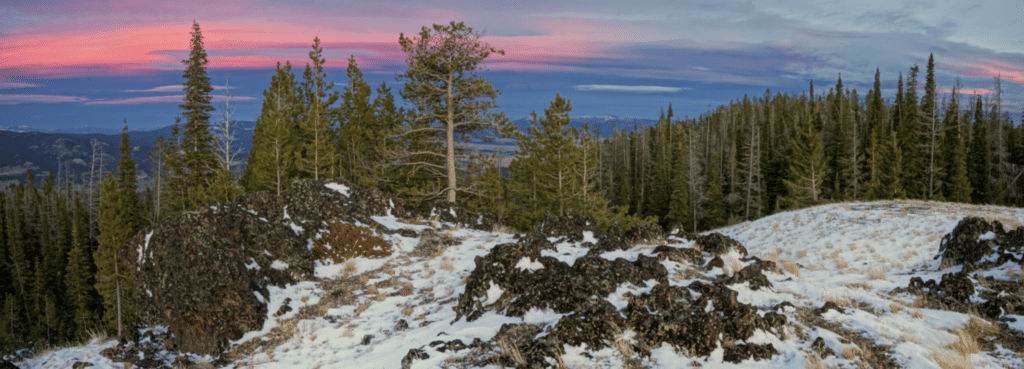
Wilderness Study Areas were created because they represent some of the best roadless wild country that remains on US federal lands and they qualify as potentially becoming federal wilderness areas in the future. Wilderness areas forbid the kind of heavy handed human activity inside them that occurs on most other federal lands except for national parks and, as a result, they are places where wild animals, sensitive to human disturbance, find hospitable to survival.
WSAs were themselves the product of negotiated political compromises made by earlier generations—comprises that resulted in other Forest Service and BLM wildllands being turned over to what Daines calls “general management” multiple use, meaning being logged, circuited with roads, mined, grazed by livestock often accompanied by management with intolerance for public wildlife carnivores (bears, wolves, mountain lions and coyotes) and used as playgrounds for motorized recreation.
It’s important to note: when WSAs were created in the 1970s, the kind of mobile, off-road, high-horsepower motorized thrill craft and SUVs that roar forth now did not exist in number or ability to reach remote places; nor were many many millions of dollars being spent each year by their manufacturers sending the message that public lands are infinite and nature ought to be treated like an X-Games obstacle course.
As Daines correctly explained, the original intent of earlier Congresses, who created WSAs, was to study the suitability of their potential elevation to full-blown Wilderness status. Again, many lands that also likely could have qualified as Wilderness and were part of a federal land inventory, were instead given over to mechanized uses.
What Daines does not say is that Congressional conservatives like him have consistently and deliberately blocked that elevation of protected status to Wilderness from happening. Moreover, Forest Service managers in many of its management regions in the West did not abide by federal law requiring them to caretake WSAs as if they were wilderness but instead allowed illegal users to trespass, thus breaking the law.
Digest that fact again: It was the Forest Service and BLM, which claims some WSAs do not meet wilderness standards, that caused this to be so, through their own inept stewardship and inability to enforce the National Forest Management Act or, in the BLM’s case, the Federal Land Policy and Management Act, that led to their alleged disqualification.
Another thing Senator Daines correctly said, albeit with no small amount of irony, was this: “There is so much disinformation and frankly lying going on with the issue but I want to set the record very very straight.”
Unfortunately, the senator isn’t coming close to his goal of setting “the record very very straight,” the same as he is failing when it comes to being honest about climate change and the cause of it.
Since WSAs were created, they have not, despite what Daines says, “been studied to death.” What has happened is that advances in scientific understanding have led hunters and anglers, wildlife watchers, those who value clean water and solitude, to better realize why WSAs are ever more priceless in the modern world by simply being left alone.
Daines’ bill to undo three WSAs in Montana is part of a strategy, many say, to undo protections across the country pertaining to some existing capital W Wilderness, national monuments, the Boundary Waters in northern Minnesota, and tens of millions of acres of Forest Service Roadless lands—all of which are treasured by sportsmen who value real conservation.
Contrary to the senator’s assertions, it is not that road-free WSAs are antiquated or have cost jobs; they actually hold more ecological relevancy for what they represent now than ever and their unspoiled state represents a gift to Montanans and Americans in the future looking back at us now.
At a recent hearing, Daines accused conservationists, who want to keep WSAs as they are, of lying. He claims that advocates are fibbing about the negative consequences of what happens when bulldozers are allowed to blaze networks of new roads into virgin public lands, carry out logging under the debatable guise of “wildfire prevention,” and facilitating a new invasion of motorized and mechanized recreation into those areas for the first time in human history.
Montana and some other Western states are different from other regions because they still have WSAs on the map, whether Daines is able to understand that or not. Another argument made by the senator is that motorized interests and mountain bikers need more access—as if there isn’t already plenty of places for mechanized recreationists to play on public lands, be it a person who is young and fit, fat, old or addled. How much is enough?
As if there isn’t already plenty of places for mechanized recreationists to play on public lands, be it a person young and fit, fat, old or addled. A quick check shows that in Montana alone, there are at least 2,300 trails covering more than 15,000 miles of pathways and two-track roads on federal public. That’s enough to go back and forth between the Atlantic and Pacific oceans five times. Of this 6000 miles of trails and tens of thousands of miles of backroads on BLM, Forest Service and other lands are open to ATV/motorized users. And this doesn’t include the proliferating number of illegal trails being created by motorized users and mountain bikers, but aren’t being halted because the Forest Service and BLM admit they don’t have adequate staffing to prevent it from happening.
A quick check shows that in Montana alone, there are at least 2,300 trails covering more than 15,000 miles of pathways and two-track roads on federal public. That’s enough to go back and forth between the Atlantic and Pacific oceans five times. Of this, 6000 miles of trails and tens of thousands of miles of backroads on BLM, Forest Service and other lands are open to ATV/motorized users. This doesn’t include state lands, wildlife refuges, nor does it include the proliferating number of illegal trails being created by motorized users and mountain bikers, but aren’t being halted because the Forest Service and BLM admit they don’t have adequate staffing to prevent it from happening.
What doesn’t exist in such abundance are places home to thriving native wildlife diversity found nowhere else but a few states. Montana, Wyoming and Idaho are three of those and it’s why they have mystique. Animals like elk, moose, mule deer, bighorn sheep, mountain goats, wolves, grizzlies and black bears, mountain lions, wolverines and Canada lynx, native trout, and an incredible diverse assemblage of bird life inhabit WSAs.
Unlike references by Daines and others that WSAs are practically worthless without extraction happening inside theme, there’s another view. At the Daines hearing, one senior leader with the BLM said he wanted do away with WSAs, because they “complicate” multiple use natural resource extraction.
Many WSAs in Montana, in terms of the caliber of wildlife they hold, are, by that status, wilder than all of the national parks in the West, except for Yellowstone, Glacier and Grand Teton. And, because of that, hunters and anglers, who know wildlife needs secure habitat, are actually outraged by what Daines is doing. He does not have overwhelming support and the justification for his move is, observers say, purely political..
Longtime Montanans, many of whom are living inductees into the Montana Outdoor Hall of Fame and have been conservation heroes, say the name of Daine’s bill is frankly, ridiculous. One might also ask Donald Trump Jr., an avowed sportsmen, whether he prefers to hunt in roadless lands and WSAs or desires to stalk stressed out game in a maze of clearcuts, roads, the sounds of throttling machines and plenty of other hunters?
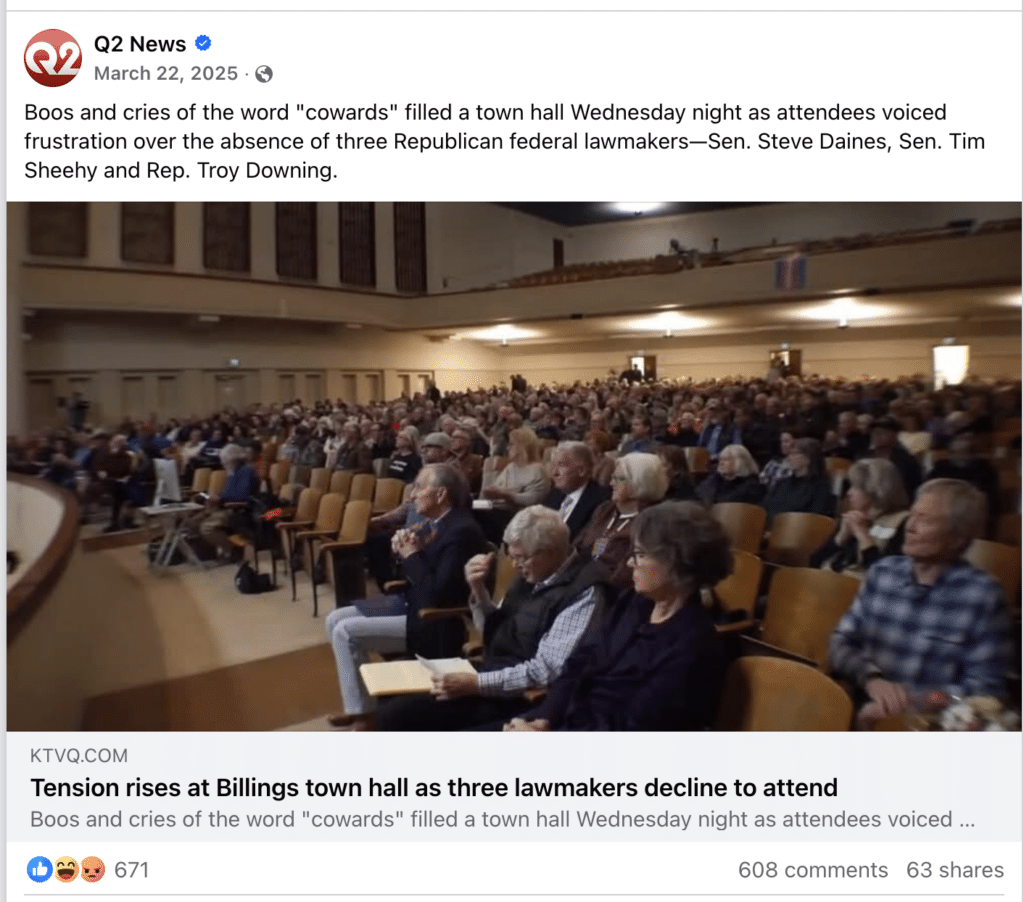
In recent years, Daines has demonstrated a proclivity for evading town hall meetings because he is wary of confronting pushback from citizens passionate about holding onto the still- wild Montana they love. He and other members of Montana’s Congressional Delegation have declined invitations to stand before constituents, or under the advice of GOP advisors in Washington DC they just don’t show up.
Longtime Montanans, many of whom are living inductees into the Montana Outdoor Hall of Fame, say the name of Daine’s bill is misleading and ridiculous. One might also ask Donald Trump Jr., an avowed sportsmen, whether he prefers to hunt in roadless lands or desires to stalk stressed out game in a maze of clearcuts, roads, the sound of throttling machines and plenty of other hunters?
The Gallatin Wildlife Association encouraged Daines to withdraw his bill. “Your constant and continuous proclamation that these WSA lands need to be returned to multiple-use management has and is falling on unsympathetic ears,” it wrote in a letter to the senator. ” Instead, we encourage you and the U.S. Forest Service to facilitate actions that gather a true and honest characterization of these designated landscapes based upon science and public approval. Once and for all, we need to let those discussions guide us in the future management of WSAs. What we don’t want, and need, is a heavy-handed approach led by those standing to gain financially from resource exploitation and/or extraction.”
So far, no members of Congress have suggested that, as recompense for federal agencies allowing WSAs to be degraded, that other WSAs be created out of existing high-value inventoried roadless lands and that a lot more national forest or BLM land be set aside with the highest status of land protection, Wilderness. This includes lands in the Greater Yellowstone Ecosystem that harbor world-class wildlife that move in and out of Yellowstone National Park.
° ° ° °
This brings us back to the earlier allusion to Sen. Daines as a high school speech and debate champion. Over the decades, I’ve had the good fortune of knowing and respecting many great young people in my town who have competed on Bozeman’s highly-regarded speech and debate team. On occasion, I’ve been among the judges at competitions. Among the virtues touted and enforced by coaches is honesty when it comes to staking out positions, but more important is supporting arguments with evidence, and delivering it with poise and respect for opponents. A competitor who cannot support assertions based on facts loses the debate.
Being called out by coaches or marked down by judges in meets, if there is any suspicion that participants engaged in deception, cheated or violated codes of conduct, can lead to rebuke and/or disqualification. To artfully win a forensics match, on one’s wits, integrity and knowledge, represents the highest form of rhetorical pugilism. It imparts lessons that last for life and engenders personal confidence. The learned skills of comity are the bedrock of having a civil society. [The word “comity” is an important word for anyone to have in their vocabulary and use it as a test for judging the behavior of 21st century politicians].
In recent years, members of the Bozeman Hawkers speech and debate team have been reminded of two notable alumni: yes, elected official Steve Daines, Class of 1980, and Michael McFaul, who served as former US Ambassador to Russia during the Obama Administration. Daines and McFaul were formidable debate partners competing in public policy.
Daines has said the experience helped prepare him for his tenure in public service and today the stakes are obviously much higher than when he was in high school. He’s been held up to the kids in Bozeman’s speech and debate program as a person worthy of their emulation. That is a high honor and it brings with it responsibility. One wonders: what statesman did Sen. Daines dream of emulating when he was their age, and did that person behave as Daines is now—playing fast and loose with his interpretation of science and staking out positions that will forever alter the quality of public lands which belong to all Americans.
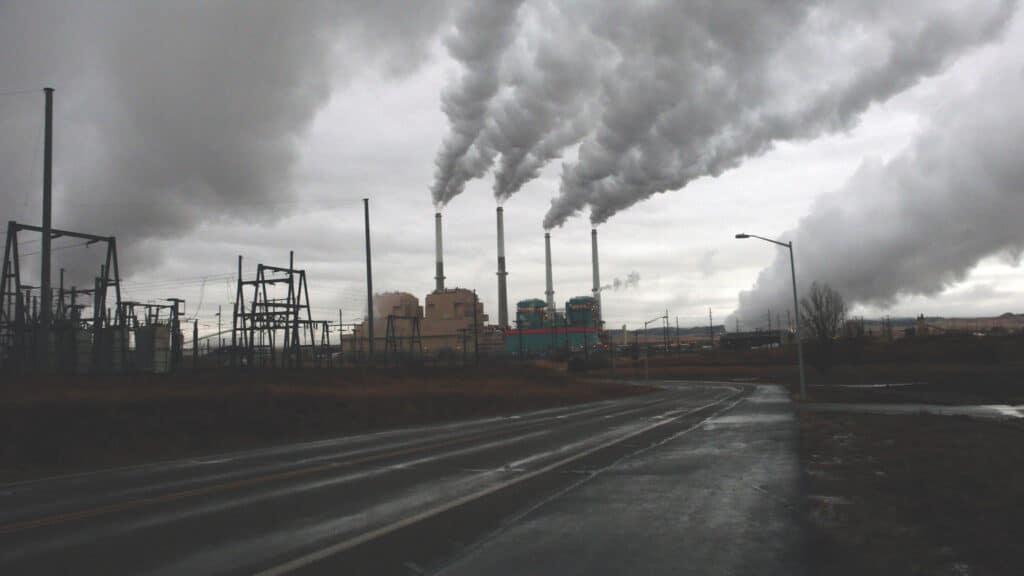
The cornerstone of speech and debate is understanding American civics and the grand tradition of citizens and the free press holding elected officials to account. Climate change is directly and indirectly affecting every American,from the Arctic tundra to the coasts and interior of the West, yet Sen. Daines pretends there is not cause and effect. He is wrong. Read the special issue of the journal Yellowstone Science from a decade ago that illustrates the deepening effects of climate change on the park through decades of data collection and this overview from NASA.
The senator says he is promoting American energy dominance by unleashing the burning of more fossil fuels. He and his friend, Montana Gov. Greg Gianforte, for whom Daines worked as an executive when Gianforte owned his company, RightNow Technology, favor what they call an “all of the above” strategy for generating energy. This entails markedly expanding the grid of solar and wind power generation, plus hydro, but they admit coal and oil and gas shoulder the biggest load. Daines also has claimed in hearings on Capitol Hill that Democrats has stifled and want to immediately shut down all fossil fuel production which, as data shows, is erroneous. They, like most pragmatists, know that fossil fuels will necessarily play a crucial role, for the next 50 years, in transitioning to a carbon-neutral or net-negative economy.
Daines appears to have little reflection on the consequences of burning a lot more fuel, nixing fuel efficiency standards, and denying modern science—and indeed these questions would make for great prompts in a speech and debate competition. Questions that he evades are these: What good is generating a lot of power if, through the cause and effect of burning more fossil fuels, it results in a drier climate that causes crop yields of farmers to crash or ranchers unable to sustain livestock? And if it leads to water being shorter in supply? And forests drying out and whether logged or burned, not growing back but dry conditions still producing wildfires in the forms of burning grasses? What good is having energy now if future generations of rural Westerners inherit landscapes that don’t support their livelihoods? What does it say to descendants about elected officials who were well aware of the consequences but because of prioritizing their own self interest, did little to slow it down?
There is no scenario, peer-reviewed by reputable scientists, that proves putting a lot more carbon into the atmosphere will make the world more hospitably habitable for humans in the next 20, 50 or 100 years.
There is no scenario, peer-reviewed by reputable scientists, that proves putting a lot more carbon into the atmosphere will make the world more hospitably habitable for humans in the next 20, 50 or 100 years.
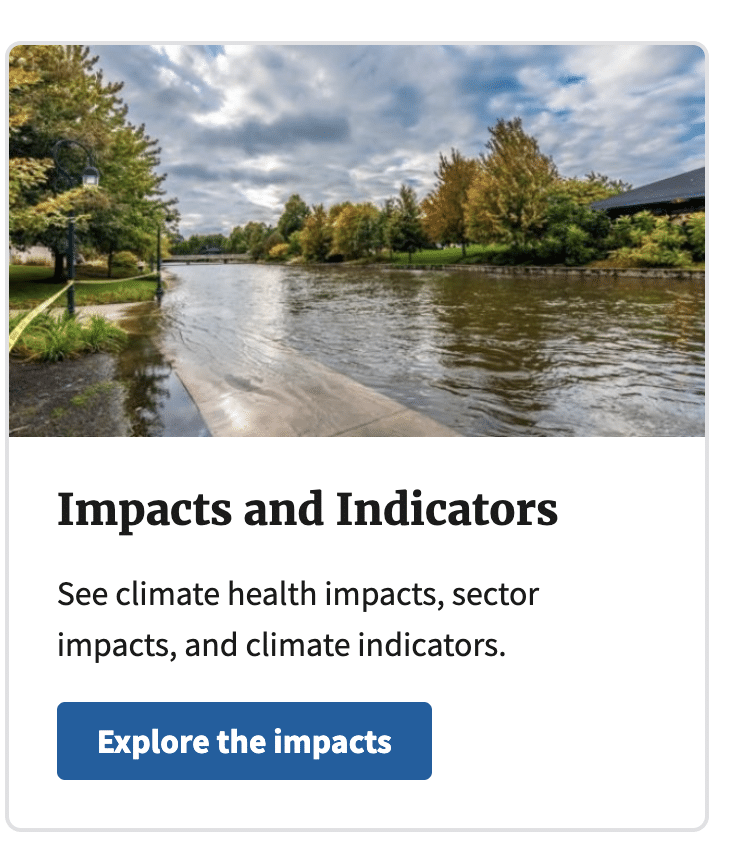
On February 12, 2026, EPA Administrator Lee Zeldin joined President Trump in The White House Roosevelt Room and announced what they called “the single largest de-regulatory action in US history” which brings an end to regulating greenhouse gas emissions. Zeldin said that “maintaining GHG emission standards is not necessary for EPA to fulfill its core mission of protecting human health and the environment.” EPA has completely re-written the webpage that describes natural causes of climate change but no longer notes the primary source of carbon emissions is from burning fossil fuels. In the old feature where one could click a button to “explore the impacts and indicators” of climate change, it delivers one to a page that reads, “Sorry, but this web page does not exist.” (See below). Also read the essay by one of Montana’s foremost climate scientists Dr. Cathy Whitlock who wrote a response.
Daines, who has an undergraduate degree in chemical engineering from Montana State University, cheered the announcement. He claims that taking action on climate change “will hurt families and the economy.” What’s hurting families and the economy is deception about what awaits if we continue to pretend human-caused climate change doesn’t exist.

° ° ° °
Were Daines or members of Montana’s Congressional Delegation to show up at a town hall, and were they to be engaged by a serious journalist, they might be pressed on these matters: Explain what they sees Montana and other states in the Northern Rockies looking like in another 20 or 30 years if their re-regulation of natural resource extraction plays out? How will the ag and tourist industries be dealing with crop failures, possible water shortages as well as water quality issues from sprawl and private development going largely unscrutinized?
Who will be footing the bill for public fire protection provided on behalf of thousands of private homeowners filling the mountainous and forested Wildland Urban Interface which is going to burn even if forests are “thinned.” How will fish and wildlife be faring?
As a conservative, where does Daines think the line between people who want smaller government and hate paying taxes begin and end when those same people demand government assistance?
As an illustration of the above, consider tariffs. Read what the libertarian, center-right, free-market Cato Institute says about Trump tariffs, which Daines supports whole hog. The Cato essay is titled: “Whom Should Farmers Believe: The President or Their Lying Eyes.” Listen to Daines explain why he supported a $12 billion federal bailout for farmers suffering from hardship caused by the President’s tariffs the senator backed but which resulted in farmers and ranchers losing access to foreign markets and many being pushed by government action into deeper economic hardship. That $12 billion relief is on top of $30 billion in earlier aid. In the parlance of “free-market” economics and limited government, which Daines claims to be promoting, such relief would be called something else: state-sponsored socialism
These are issues that a real statesman should answer to. They also expose the deep contradictions of “free market economics,” so-called, that Daines is pushing, highlight why they’ve failed in the past and, why those failings should be avoided in the future as part of the precautionary principle.
° ° ° °
So, let’s look at where climate change and forest thinning converge. It is an intersection where observers say the biggest hypocrisy resides. The same politicians who deny the science of climate change are advancing an argument that forests need to be logged in order for them to achieve better forest health due to alleged problems that are, ironically, being exacerbated by a changing climate.
Read an essay from atmospheric scientist Dr. James Hansen and environmental attorney Dan Galpern about forest thinning in a West becoming hotter and drier. Hansen was the NASA scientist who delivered the first ever real scientific testimony on Capitol Hill, in 1988, about climate change. It came during the month of June when the historic forest fires of Yellowstone were just beginning to flare following a winter of incredibly low snowpack and the arrival of hot weather.
The ‘88 fires, which I covered as a journalist, roared not because there weren’t roads there to halt their advance (indeed the Forest Service used bulldozers to build fire lines but to no effect). Dry conditions and strong winds pushed sparking embers long distances ahead, igniting trees and grasses on the forest floors. Even hundreds of National Guard members were called in to assist. The flames were unstoppable. Some of the fires of 1988, and blazes that have happened in years since moved across former clearcuts. Many of the largest blazes in Montana have been prairie fires racing across hundreds of thousands of acres. Watch this short clip of a wildfire in Grand Teton National Park. No, the presence of a road did not halt the advance of a wildfire driven by strong winds carrying burning embers into dry terrain.
The ‘88 Yellowstone fires, which I covered as a journalist, roared not because there weren’t roads there to halt their advance (indeed the Forest Service used bulldozers to build fire lines but to no effect). Dry conditions and strong winds pushed sparking embers long distances ahead, igniting trees and grasses on the forest floors. Even hundreds of National Guard members were called in to assist. The flames were unstoppable. Some of the fires of 1988, and blazes that have happened in years since moved across former clearcuts. Many of the largest blazes in Montana have been prairie fires racing across hundreds of thousands of acres.
Notably, Montana’s second US Senator Tim Sheehy, born in 1985, was a toddler back in Minnesota and just three years old when the 1988 fires burned in Yellowstone. Hansen warned in his testimony before Congress that year that sending more carbon-dense greenhouse gases into the atmosphere, through the burning of fossil fuels, would bring serious consequences, especially to regions like the West already suffering from aridity.
He said more forests would turn tinder dry. He was right. His findings have been corroborated by hundreds of studies, including a series of reports led by Dr. Cathy Whitlock of Bozeman, an eminent scientific voice and fellow of the National Academies of Science. In Missoula, there is also the work of Dr. Steve Running, who was part of a scientific team awarded a Nobel Prize and he was recently ranked among the top environmental scientists globally.
Daines and Sheehy glibly dismiss the mountain of peer-reviewed science—a no-no among high school speech and debate champions— as well as the winter we’re having now as being little more than mere weather. But weather over time creates trackable trendlines in climate. The Colorado River Basin is, undeniably, in a 26 year drought, with water demands from human development outstripping availability even during “normal years.” In Utah, the Great Salt Lake is dying from overuse of water combined with diminishing precipitation related to the trendlines of climate change.
Neither political leaders in the Colorado Basin nor those representing Salt Lake City and environs ever had a backup plan for pushing an agenda of resource consumption without consequences. That’s because for decades they lived in denial of the future that has no arrived and action delayed means dealing with dire consequences.
It’s weird how perverse incentives work when they enter the political arena. Before he was elected to the Senate, Sheehy founded a company that specializes in making aerial water tankers available for hire to federal and state firefighting agencies Those contracts are lucrative for his former company, which Sheehy says no longer has ties to. He and Daines have been major advocates for forest thinning and, yes, bolstering firefighting capability. It’s a bullish business sector.
Neither they nor their colleagues say anything about the massive inflow of people building homes in the Wildland Urban Interface, often adjacent to public lands, and markedly increasing the vulnerability of human structures and lives being lost to fire. They have no problem devoting a significant amount of taxpayer money to essentially providing free wildfire protection for humans who, exercising their own free-will and liberty, voluntarily put their lives and property in harm’s way. Both of the senators to hang out in Big Sky with plutocrats who contribute to their political campaigns. When and if a place like Big Sky burns, will they push for taxpayer-backed federal relief to help the well-to-do rebuild their mansions?
Risk of wildfire would be radically lessened if humans weren’t moving inhibited into forested settings and the more they do it hobbles the ability of the Forest Service to do prescribed burning.
Free market advocates, who claim to be credible researchers, are pushing for both more thinning to “heal forests” in roadless areas that aren’t sick, and simultaneously are evasive when it comes to accepting the science of climate change. They and Daines and Sheehy also like to say that Forest Service leadership supports opening up roadless areas to cutting. Sen. Sheehy was earlier a board member of a Bozeman-based free market research thinktank pushing that agenda.
It is said one can judge the credibility and character of people by the caliber of friends they keep or vouch for professionally. In February, Daines and Idaho Sen. Jim Risch, as members of the US Foreign Relations Committee, proudly provided an introduction for Bozeman resident Jeremy Carl, as part of the confirmation process for Carl to become Assistant Secretary of State for the United Nations and International Organizations. Read this story by Darrell Ehrlick of The Daily Montanan about Carl and his controversial views on race and other topics. With Daines standing behind him, is Mr. Carl representative of the Montana values that state wants to be projecting to the rest of the world? Even when all the facts about Carl’s views were exposed, Daines gave him his imprimatur. [Update: On March 10, Carl withdrew his name from consideration from the post after it appeared he had not won sufficient support for confirmation from the GOP-controlled Senate, thorough Daines remained silent, even after Carl came under withering scrutiny].
Meanwhile, the Trump Administration’s nominee to head the Bureau of Land Management, Stevan Pearce of New Mexico, has an established record as a Congressman in pushing to sell off or privatize federal public land and radically weaken laws such as the Wilderness Act. Yes, Daines and Sheehy support Pearce’s nomination—even though a recent poll of Montanans says 75 percent of those contacted are opposed to him getting the job. Roughly half of those surveyed identify as hunters and anglers. One critic said that having Pearce in charge of the BLM’s 245 million acres is akin to a Christian congregation hiring a new preacher who disavows the teachings of Jesus.Read Andrew McKean’s assessment of Pearce which he penned for the hunting magazine, Outdoor Life.
The Trump Administration’s nominee to head the Bureau of Land Management, Steve Pearce of New Mexico, has an established record as a Congressman in pushing to sell off or privatize federal public land and radically weaken laws such as the Wilderness Act. Yes, Daines and Sheehy support Pearce’s nomination—even though a recent poll of Montanans says 75 percent of those contacted are opposed to him getting the job. Roughly half of those surveyed identify as hunters and anglers. One critic said that having Pearce in charge of the BLM’s 245 million acres is akin to a Christian congregation hiring a new preacher who disavows the teachings of Jesus.
As part of Daines’ Montana Sportsmen Conservation Act, Daines said officials from the Forest Service and BLM support his push to undue wilderness study areas. Except that few Montanans, few Americans, can remember agreeing to give up those Wilderness Study Areas to multiple use and forest thinning.
In addition, here is a little bit of real-world insight gleaned from four decades of reporting and holding the feet of both Democratic and Republican elected officials to the fire. If members of Congress, who control the purse strings for the Forest Service and BLM, call forth agency bigwigs or political appointees to testify, and they make clear that the correct answer to any questions they pose is “We need to be cutting more trees,” what does one think the recommendation from officials representing those agencies will be?
This kind of pre-ordained policy making is not a new phenomenon. During the timber wars of the 1980s and 1990s, federal lawmakers from timber states, whose election campaigns were backed by timber interests, made it clear how they wanted federal appropriations to be spent and national forests managed—to generate logs whether it was sustainable and compatible with ecosystem health or not.
This included taxpayers subsidizing the construction of tens of thousands of miles of logging roads to facilitate below cost timber sales (in which the value of the board feet was less than the cost of removing the trees) to ensure that timber companies profited. Again, some might call that an example of state-sponsored socialism benefitting resource extraction industries.
But it came with an even bigger tab: taxpayers also have had to foot the bill to restore forests, watersheds, fish and wildlife populations that suffered ecological harm from over-harvest and roadbuilding.
As a journalist who wrote a book about scientific whistleblowers (Science Under Siege: The Politicians’ War on Nature and Truth, published in 1998,) I can tell you the same pressures that exist now existed then. Agency scientists who had data documenting the destructive effects of clearcutting on wildlife, fish, water quality and scenic beauty were intimidated by their agency superiors beholden to politicians and the timber industry. They were harassed, ordered to be silent, transferred to the equivalent of bureaucratic Siberias if they insisted on keeping the public informed, and/or they were forced out. Basically, they had their careers destroyed for speaking the truth. Today, morale has plummeted in federal agencies and fear abounds.
Agency scientists who had data documenting the destructive effects of clearcutting on wildlife, fish, water quality and scenic beauty were intimidated by their agency superiors beholden to politicians and the timber industry. They were harassed, ordered to be silent, transferred to the equivalent of bureaucratic Siberias if they insisted on keeping the public informed, and/or they were forced out. Basically, they had their careers destroyed for speaking the truth.
US Forest Service Chief Tom Schultz says he is leading the agency “back of basics”—which already is employing many of the tactics above—and which veterans of the agency say is the absolute worst direction because it runs counter to the science of wildlife, watershed protection and climate. Schultz also favors the failed tactic of trying to suppress most fires, which experts say makes problems worse—this coming from the leader of the Forest Service.
A recent scientific meta-analysis looking at different kinds of forest “treatments” across the West came to this conclusion: Thinning-only is significantly less effective than undertaking a combination of thinning, lighting controlled prescribed fires, and allowing fires to burn.
This departs from Forest Service Chief Schultz’s talk about suppressing fires which is expensive and not often successful. Plus, people who build homes in forested areas often are uncomfortable having prescribed fires nearby on public lands and increasingly dry conditions narrow windows when they can be employed. Finally, other studies show that expensive forest thinning not accompanied by regular reduction of brush and grasses in understories reduces the efficacy oof thinning.
Hansen and Galpern, point by point, disassembled the arguments made by members of both the House and Senate who are now advancing a bill called the “Fix Our Forests Act.” Daines and Sheehy are two of those. Hansen and Galpern, however, say the bill masquerades as a guise to achieve better forest health but is really a Trojan Horse ploy by the timber and other industries. As Hansen notes, and as was shown in Yellowstone in 1988, traditional notions of silviculture and fire suppression are obsolete.
They’ve been made so by shifting conditions in western forests—drier and hotter and exacerbated by high winds—that are a product of a changing climate. Thinning doesn’t stop embers, it doesn’t deal with the grass problem and it requires constant expensive tending with studies showing that treatments lose half of their effectiveness in just a decade.
The remedy is not toppling old growth forests—which is what the timber industry is really after with its invasion of roadless areas—in order to allegedly “save them.” Old growth forests, also protected by the Roadless Rule which Is being targeted for rescinding, are important refugia for wildlife and they function as filters for clean water.
° ° ° ° °
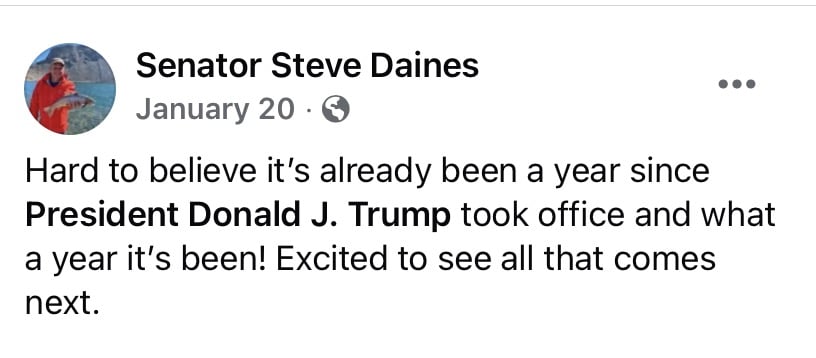
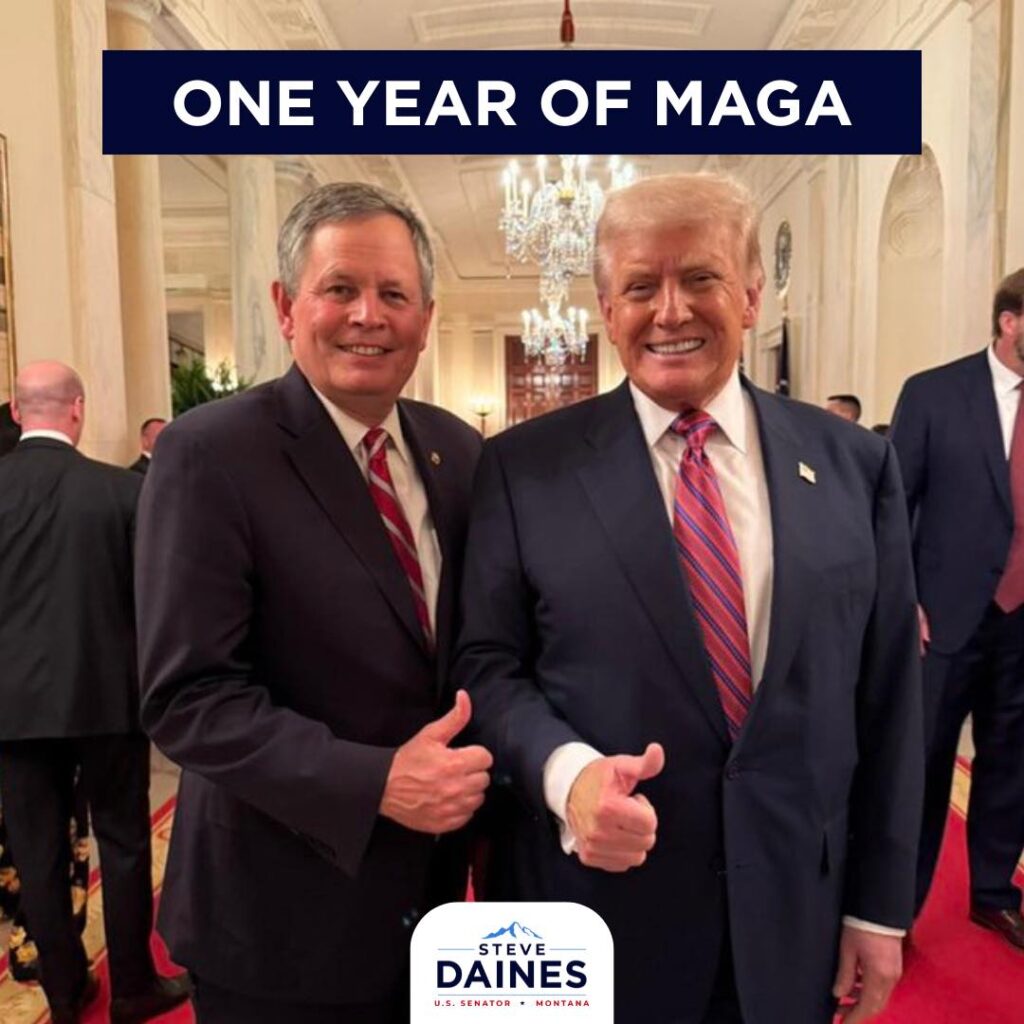
Steve Daines believes America is “a Christian nation.” He reportedly is a parishioner, Born Again, who attends an evangelical church, which means he answers to a power ostensibly higher and more omnipotent in his estimation than even President Trump. Daines in his pro-life posturing claims to be a champion for the unborn, but what about the unborn of future generations who will inherit a lesser world based on his own actions?
As any preacher with integrity standing before the Almighty knows, something worth remembering is right there, in the Old Testament, Exodus 20:16, Number 9 of the Ten Commandments. It says: “Thou [you, we, us] shall not bear false witness against our neighbor.”
The gist of that commandment simply means don’t make stuff up you know is wrong about others. It’s a sin recognized in both the Old and New Testaments. According to the spirit of the Good Book, bearing false witness means “avoiding any misrepresentation of reality that hurts another person, including lying, perjury, slander, gossip, or twisting the truth. It requires honesty in both legal testimony and everyday speech to protect a neighbor’s reputation and well-being.” The work of Congress involves legal testimony, and bearing false witness would get a competitor tossed out of a high school speech and debate meet.
Regarding an elected official who identifies as a Christian serving in Congress, what kind of person of faith would ignore, or try to refute, the pronouncement of the 2015 encyclical Laudato Si, and 2023’s Laudate Deum that discusses climate change— both issued by the late Pope Francis, who said the environmental crisis is a moral, social and spiritual issue. Francis said everything is inextricably intertwined—climate change, destruction of nature and the clash of opulent materialism vs. human poverty. He cited Pope John Paul II’s encyclical that condemned those who “frequently seem ‘to see no other meaning in their natural environment than what serves for immediate use and consumption.'” The pontiff lashed out against willful ignorance of those who deny climate change exists.
Does Sen. Daines think he is smarter on matters of Christian faith than a Pope or on climate compared to a career atmospheric expert with a proven track record for accuracy like James Hansen?
Daines accuses conservationists, who echo Francis’s and Hansen’s conclusions, of lying, of being “radicals” and “extremists.” Is he thus bearing false witness by impugning the reputations of respected scientists, and the irrefutable body of evidence about climate change, compiled by leading experts, who don’t have a political, economic or nefarious religious agenda?
He’s arguably using the same tactic when he falsely claims in a press released issued by his office that if Wilderness Study Areas or Roadless Lands are opened up to energy development, logging, roadbuilding, coal mining and motorized recreation, that those activities will be subjected to the same level of scientific review and public scrutiny they’ve always had.
This, too, is brazenly untruthful and he knows it is. How do we know that? Because Daines and members of Montana’s and other Congressional delegations, with deliberate intent, are now actively involved with—and in tandem with the Trump Administration—stripping away key provisions of the National Environmental Policy Act and other codes that allow scientific review and public scrutiny of proposed natural resource extraction. He and other politicians are seeking to limit the hard-fought right of citizens to comment and legally challenge decisions, with the merits of their arguments adjudicated in a court of law.
The public either doesn’t recognize or has forgotten how many major destructive natural resource projects were either prevented or improved because of scientific and public concern raised about their impacts. In some cases, the public’s right to sue stopped them. A giant gold mine would located just outside the northeast corner of Yellowstone Park near Cooke City, Montana today is one example. Major portions of Yellowstone and Paradise Valley, Montana would be under water today if proposed dam projects for the Yellowstone and other rivers were not challenged. The floor of breathtaking Jackson Hole, from the Teton mountains east to the Gros Ventres, would be covered in sprawl today if not for the creation of Grand Teton National Park as a public land.
Often, conservation-minded civil servants played a vital role. In 2025, Western delegations characterized federal agencies at being bloated and inefficient at the same time they support spending $1 trillion on military spending. They supported the rogue activities of DOGE that led to the firings of veteran employees in land management agencies or caused them to flee. Politicians are also attempting to hobble the credibility of science if it demonstrates their positions are at odds with facts.
Elected officials won’t show up at town hall public meetings to answer questions from all of their constituents. They have created a winner take all scenario which sends the signal that concerns expressed by all Montanans, who love their state as much as their neighbor, don’t matter unless they agree with him.
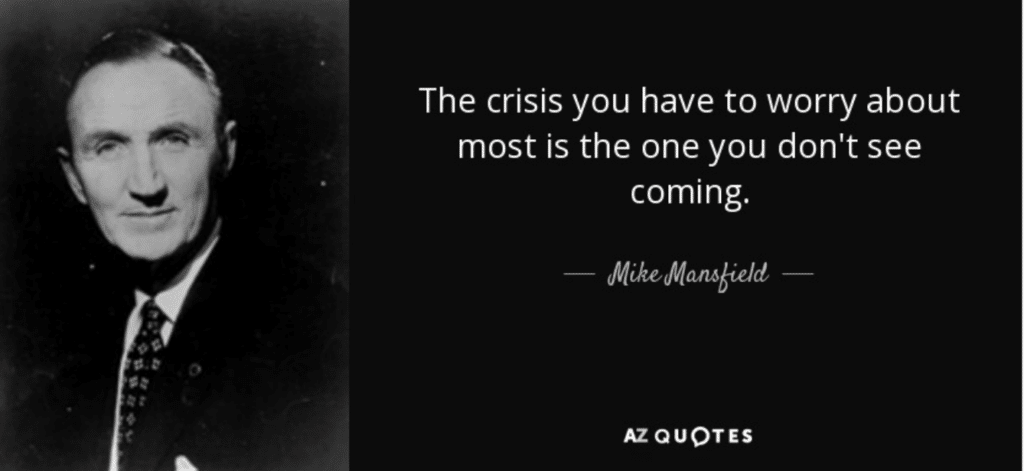
Were Mike Mansfield, the tough guy from Butte who served Montana in the House and Senate alive today—Mansfield commanded respect among people ranging from Barry Goldwater on the right to John F. Kennedy on the left—he would be calling out the thin-skinned actions of our elected officials.
Mansfield, who served in the Marines and worked in the copper mines, was plainspoken and rose to become Senate Majority Leader. He also was the leader who famously initiated the Watergate Hearings.
° ° ° °
At long last, we received a little bit of snow this winter, the cold season which ends in a few weeks.
For the forty-plus years I’ve lived in the West, one of the delights has been waiting for “lilac time” in late May and June, when the fragrant purple blossoms burst. This event of nature sparks feelings of euphoria in humans who encounter it,
On February 14, Valentine’s Day, I walked into the backyard and saw the sprout of a single lilac, three months ahead of schedule. This didn’t inspire elation. Of 135 years that snowfall has been measured in Bozeman, Montana, the accumulation this winter so far ranks 125th. As I was taking a walk in the evening on Valentine’s Day, I had a chat with a lifelong working class resident of Bozeman, who told me he identified as a Republican but he’s questioning the anti-science tribalism of his party. He said, “In my 73 years of living here I’ve never seen a dry winter like this, nothing even close. Something strange is happening with the weather and it ought to be of concern to Steve Daines who grew up here.”
The kind of whacky weather we’re having foretells lungs being filled with choking woodsmoke in summer, low water in streams, health alerts being issued cautioning people who suffer from breathing problems to not even go outside; this, in the Greater Yellowstone Ecosystem, what is supposed to one of the last idylls for clean living in the world.
So, what is the one durable American value that transcends flag, socio-economics, tribal identity, religious affiliation, morals, ethics, duty, self-interest and personal meaning? It might be this: by our healthy public lands, which together we hold in trust and the covenant exists nowhere else in the world, we are a nation of people who value some things more than money. These days, it is apparent that some are no longer able to grasp this concept.
°°°°°°°°°°°°°°°°°°°°°°°°°°°°°°°°°°°°°°°°°
A reminder: Yellowstonian is non-partisan, by its design, intent and in accordance with our non-profit status. We do not endorse individual candidates nor promote political parties or agendas. Much of our focus is on making sense of, and scrutinizing the potential ramifications of public policy decisions for public lands, public wildlife, waterways, the guarantees of a a transparency in a participatory democracy, and human quality of life in Greater Yellowstone and the American West.
Vital in considering the implications of decisions is keeping in mind the precautionary principle, which concerns cause and effect of a given action, its potential unintended consequences, costs and benefits, and, when taking risks, adhering to the adage that it’s better to look carefully before one leaps. We cannot think of a single issue more pressing for humans, society and the environment, and yet lacking in civic leadership, than the rapid advancement of Artificial Intelligence. YouTube ought not be the place where we stay informed.
The paradox of AI is that while its scaling up requires vast amounts of electrical power generation in order to run proposed data centers and accelerate its impact on every aspect of our lives, politicians claim that unleashing American energy domination to fuel it will result in the creation of jobs. And yet, the architects who created AI say it threatens to, by its purpose, obviate the need for human workers. Experts say it will bring a kind of social disruption, the likes of which the modern world hasn’t seen. At this very moment then politicians need to be meeting with constituents and having conscious adult dialogues about a future rapidly racing toward us, most are missing in action. Watch this short overview about AI concerns related to employment alone. In the essay, above, we explored how the evasion of true science-based decision making and accountability by our elected officials could not, arguably, be happening at a worse time. If you value journalism that explores these deeper questions, we’re ever grateful for your support.